
Ministries
Resources

Gregory E. Reynolds
Ordained Servant: September–October 2026
Tyndale’s New Testament at 500
Also in this issue
The Book that Changed Our World: Tyndale the Translator
by Leland Ryken
The Voice Vote that Launched the OPC
by Darryl G. Hart
Augustine: Everyman’s Preacher: A Review Article
by David C. Noe
The Way of Dante by Richard Hughes Gibson
by Charles Malcolm Wingard
by Z. Bulut Yasar
William Tyndale’s New Testament: A Biography of the Book that Changed Our World, by Leland Ryken. Christian, 2026, 202 pages, $24.95, paper.
The biography of books is a mid-twentieth century phenomenon. Princeton University Press has produced over two dozen of these under the rubric, “The Lives of Great Religious Books.” Robert Darnton (university professor and librarian at Harvard University) is largely responsible for the proliferation of the general idea of the history of books. In the book collecting world this category is known as “books on books,” everything from the history of binding to bookstores.
Leland Ryken has provided a book about the most important book in Modern English-speaking history: the 1526 edition of William Tyndale’s translation of the New Testament into Modern English. It was the first Modern English translation of the New Testament translated directly from the third edition (1522) of Erasmus’s Greek New Testament. Wycliffe and his followers translated the entire Bible into Middle English between 1382 and 1395, in handwritten form and based on the Latin Vulgate. This made Tyndale’s translation sui generis.
Ryken’s first five chapters (7–64) of William Tyndale’s New Testament cover Tyndale’s life preparing to become a Bible translator and his life as a translator, this in order to give the context for the biography of the translation itself in chapters 6 through 11 (65–132). The final three chapters deal with the legacy of Tyndale’s translation, including a chapter on the Updated American Standard Version (UASV).
Tyndale viewed his translation work as pioneering, a solution to the twin problem of widespread religious ignorance and the false teaching of the Roman Catholic Church (90). His passion was to let the “very Word of God” speak (94, see 1 Thess 2:13). Because the transitional state of English often lacked words with the appropriate semantic range to translate the Greek, Tyndale became the supreme neologist, adding over seventeen hundred words to the English language (95). (Shakespeare accomplished about the same for different reasons.) Among these Tyndale coined “atonement” and “longsuffering” (100). Besides a more accurate translation of the Greek, these works often corrected Roman Catholic errors. For example, Tyndale substituted “repent” for “do penance” (100).
A large part of Ryken’s book may be considered a multidimensional polemic against the translation philosophy of dynamic equivalence (DE, 105). Ryken contrasts DE with “Tyndale’s Philosophy of Translation” in chapter 9, favoring Tyndale’s literal “word for word” translation. As a philosophy of translation, DE adds interpretation and commentary to the original language and interprets ambiguities that should be left to the reader and preacher (105). Ryken sums up Tyndale’s criteria for good translation from what may be gleaned from Tyndale’s writings and translation itself, even though Tyndale never articulated his philosophy in detail: “The most obvious ones are clarity of communication, verbal beauty, smooth-flowing rhythm, and retention of the literary genres and rhetorical forms used by New Testament authors” (113).
Ryken makes the case that while Tyndale sought to simply render in English exactly what the Greek says, the elegance and beauty of the resulting translation lie more in the literary excellence of the Bible itself than the intent of the translator (169). By contrast, dynamic equivalence translations, such as The Message and The New Living Translation, mute the beauty and power of the original.
Chapter 10, “Language and Style,” argues against the DE contention that Tyndale’s quest for “plain style” suitable for the plough boy was what Tyndale intended (116–23). Ryken gives numerous examples of how DE translations, such as The Message and the Good News Bible, eviscerate the text of figurative language and dilute its power (116–17). Tyndale used standard formal English suited for a wide range of readers and hearers (123).
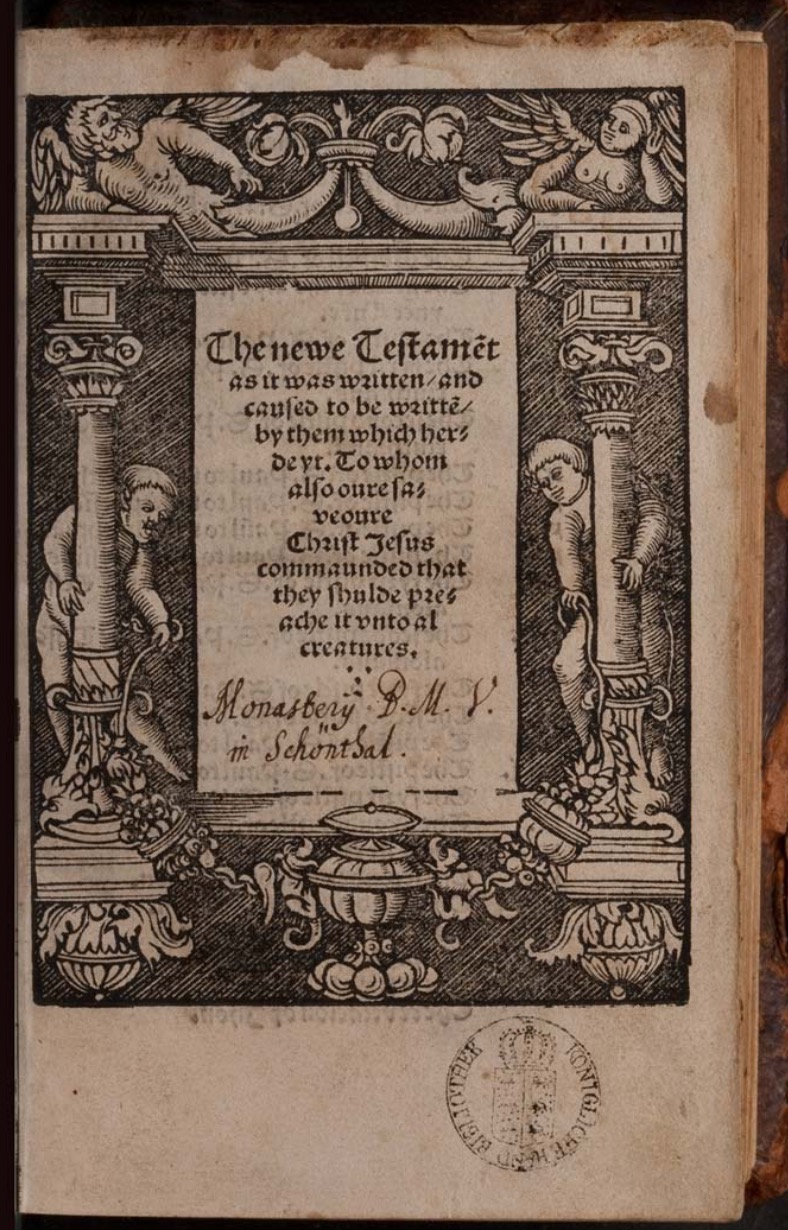
This book is a wealth of detailed information not only about Tyndale’s translation but also about the process of translation and the subsequent influence of Tyndale on that process with his pioneering work. The chapter on “Frequently Asked Questions” (7) yields a treasure trove of historical information. One discovers things like the remarkable fact that Tyndale made four thousand changes in his 1534 translation, eight years after the first edition of 1526 (85). With proper scholarly and Christian humility, he saw his work as a pioneering rather than a definitive effort. He was committed to continuous revision and improvement (141–42). The original 1526 edition is almost unreadable for modern readers because it was printed in black letter, old Gothic typeface (83). Furthermore, the English of his era was in transition from Middle to Modern English and thus spelling and grammar were rough and unrefined in contrast to the English of the later Elizabethan era evident in the King James Version (KJV, 81). Another remarkable fact is that “approximately eighty-three percent of the Tyndale’s New Testament is duplicated in the King James Bible” (87).
“Tyndale’s Influence on the History of English Bible Translation” (ch. 12) begins with a brief history of the five translations that followed Tyndale’s (136–38). Ryken then goes on to correct misinformation about Tyndale’s influence on the KJV. He demonstrates the falsehood of some scholars’ “extravagant claims that Tyndale was a forerunner of modern colloquial translations and paraphrases aimed at a target audience of grade schoolers” (139).
The penultimate chapter (ch. 13) is a fascinating exploration of Tyndale’s influence on the English language. The proliferation of group readings of the illegally smuggled New Testament along with preaching meant that the number of people influenced by Tyndale’s translation was out of proportion to the number printed (146–47, at the most twenty thousand were printed). The list of words and phrases that are still present in English usage is remarkable. The following are a few words and phrases: intercession, beautiful, brokenhearted, busybody, taskmaster; “signs of the times” and “the powers that be” (148–49).
The book concludes with an exploration of a new translation of which I was unaware, the Updated American Standard Version (UASV). The author of this chapter is the publisher of that version. Edward Andrews maintains that the UASV is the contemporary heir of Tyndale’s legacy. He makes a case for Tyndale’s philosophy of translation versus DE. But I cannot assess the UASV since I do not possess a copy of this new version. The USAV continues the tradition of the original ASV in translating the tetragrammaton throughout the Old Testament as “Jehovah” (173).
My only criticism of this rich resource is the lack of footnotes. The convenience of the reader is most always served best by specific citation at the bottom of the page. Future editions should also consider adding indexes.
Ryken’s book is a powerful tribute to Tyndale’s landmark translation. Considering Tyndale’s willingness to be burned along with his translation, we ought to evaluate our own commitment to God’s Word.
* * *
A fascinating book on Tyndale’s influence on the English language is David Crystal’s William Tyndale and the English Language (Bodleian Library, 2026). Crystal highlights Tyndale’s hitherto unrecognized role as an early lexicographer. He unpacks the claim that more than 80 percent of subsequent translations reveal Tyndale’s influence. For example, there is a rich and detailed analysis of Tyndale’s nouns, adjectives, and verbs. He also explores the relationship between Tyndale and the King James Version. Thirteen appendixes expound the “first recorded uses” of such things as compound and abstract nouns, etc. Four special indexes, besides the general index, record items such as “first recorded uses” and “idiomatic expressions” like “the powers that be.” This is the perfect book for those who wish to dig deep. It will serve for generations as a unique study of the details of Tyndale’s contribution to the English language.
Illustration: The title page of Tyndale’s 1526 New Testament in English.
Gregory E. Reynolds is pastor emeritus of Amoskeag Presbyterian Church (OPC) in Manchester, New Hampshire, and is the editor of Ordained Servant. Ordained Servant Online, September–October, 2026
Contact the Editor: Gregory Edward Reynolds
Editorial address: Dr. Gregory Edward Reynolds,
827 Chestnut St.
Manchester, NH 03104-2522
Telephone: 603-668-3069
Electronic mail: reynolds.1@opc.org
Ordained Servant: September–October 2026
Tyndale’s New Testament at 500
Also in this issue
The Book that Changed Our World: Tyndale the Translator
by Leland Ryken
The Voice Vote that Launched the OPC
by Darryl G. Hart
Augustine: Everyman’s Preacher: A Review Article
by David C. Noe
The Way of Dante by Richard Hughes Gibson
by Charles Malcolm Wingard
by Z. Bulut Yasar
© 2026 The Orthodox Presbyterian Church


