
Ministries
Resources
John Hendrix
Reviewed by: Judith M. Dinsmore
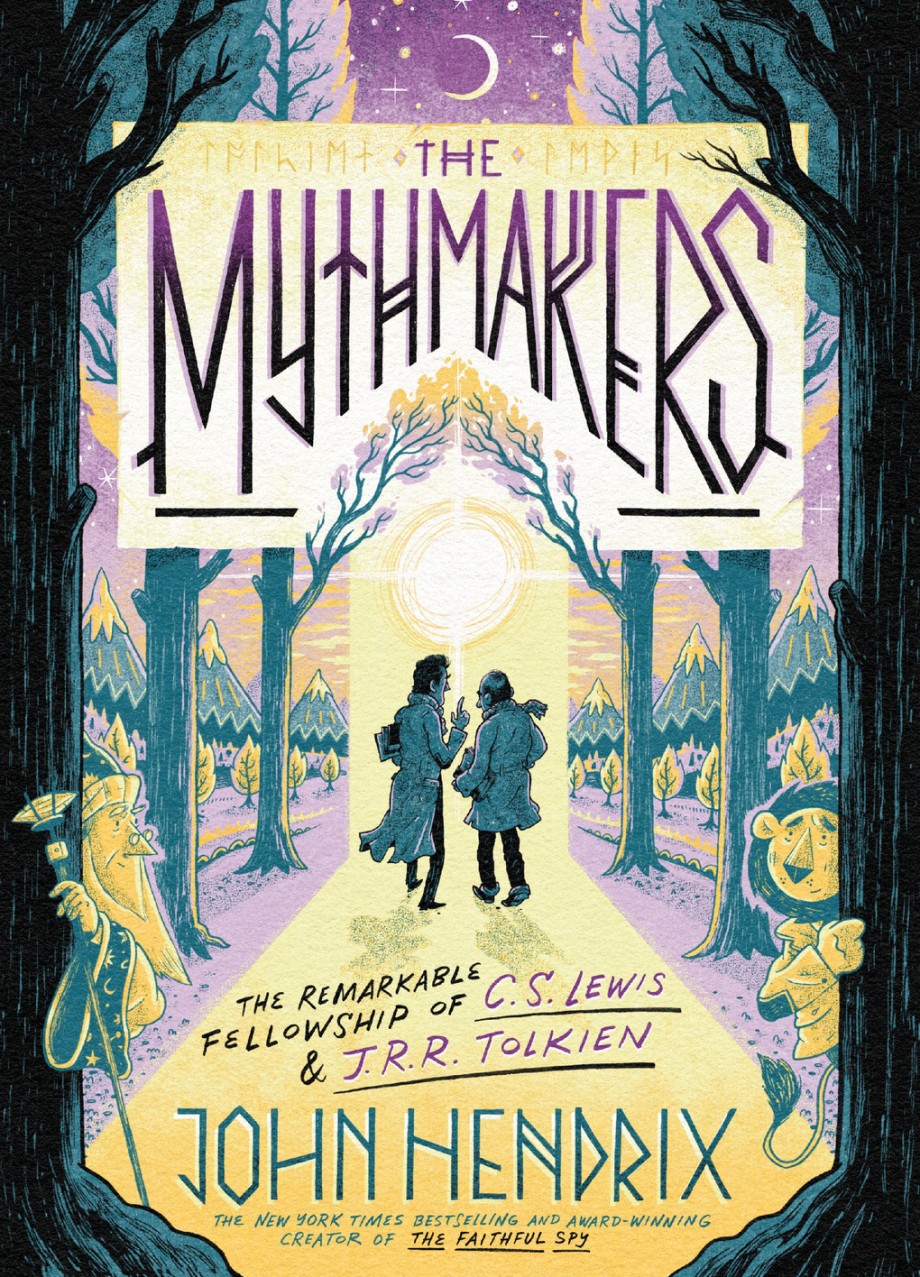
The Mythmakers: The Remarkable Fellowship of C. S. Lewis and J. R. R. Tolkien, by John Hendrix. Abrams Books, 2024. Hardcover, 224 pages, $24.99. Reviewed by Judith M. Dinsmore, New Horizons managing editor.
The author of this young adult graphic novel, John Hendrix, mixes a teenager’s enthusiasm for Narnia and Middle Earth with a professor’s enthusiasm for instruction and a believer’s intimacy with doubt, loss, and transformative faith. The resulting story of the friendship between Lewis and Tolkien, while too ambitious in scope at points, is beautifully portrayed.
Hendrix, a professor of visual arts at Washington University in St. Louis, movingly depicts Christ’s redemptive work inside the catastrophes of this world as the reader learns about Lewis’s and Tolkien’s childhoods, the devastation of war, their academic work, Lewis’s wrestling with the Spirit in his conversion, their profound support of each other artistically during the time of the gathering of the Inklings and, tragically, the coldness that came into their relationship.
Two figures, a wizard and a lion, act as the reader’s Virgil at each chapter’s opening. They make approachable discussions of literary genre and nineteenth- and twentieth-century research into myth and legend. Lewis and Tolkien shared a fascination with Norse mythology, and both wanted to write a myth for the disenchanted postwar world. Yet how different were their methods: Hendrix contrasts Tolkien’s careful creation of a logical fantasy world in Middle Earth with Lewis’s use of key images to create Narnia, borrowing more from allegory and fairy tale.
Hendrix’s attempt when the wizard and the lion enter “The Hall of Myth and Epic” to explain what a myth is does fall flat for those with a high view of Scripture; Genesis rests on a pillar in the hall alongside texts like The Epic of Gilgamesh. Joseph Campbell is later approvingly cited. That section, not central to the book, would be a good opportunity for discussion with young adult readers. “Portals” transport the reader to the back pages, where the lion and wizard interact with the learned Dr. Thistle (based on Dorothy Sayers). I read Mythmakers for book club, and we were divided fifty-fifty as to whether the lion and wizard (you can spy them on the cover) were delightful guides or a bit overdone. No teenagers were present however, and perhaps, as the book’s target audience, it is their impression that ought to carry the day.
The gorgeous art pulls the reader into the experiences of both writers: how the Dead Marshes in The Return of the King are a revisitation of Tolkien’s experience at the Battle of the Somme in World War I; how a walk in the woods deep in conversation with Tolkien and mutual friend Hugo Dyson brought Lewis into a clarity of conviction that Christ was the only “myth” who entered history; and how the inn, The Eagle and Child, was both refuge and refinery for the great minds who met there.
Part of the allure of literary biography is to bring famous writers back down to size as “real” people. Hendrix’s medium, in contrast, is especially fit to portray what is, to borrow from Lewis, more real than real: the wonder of an otherworldly grace that changes the story. Once fractured, Lewis and Tolkien’s friendship was never restored in this life—but Hendrix points us to the restoration that is to come.
September 13, 2026
September 06, 2026
August 30, 2026
John Calvin’s Illustrated Institutes, Book 1
August 23, 2026
August 16, 2026
August 09, 2026
August 02, 2026
© 2026 The Orthodox Presbyterian Church


