
Ministries
Resources
Brad Littlejohn and Chris Castaldo
Reviewed by: Larry E. Wilson
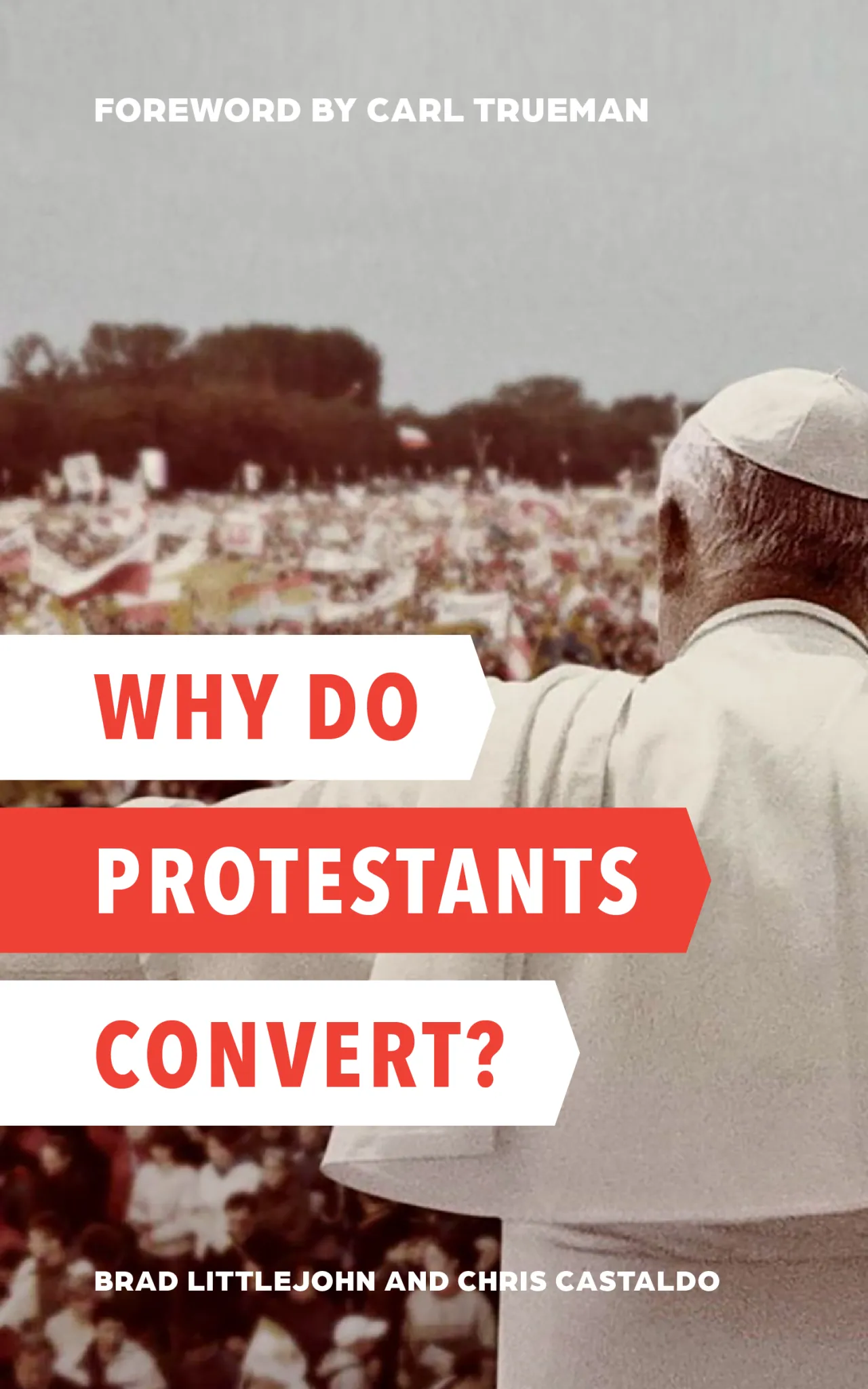
Why Do Protestants Convert? by Brad Littlejohn and Chris Castaldo (foreword by Carl Trueman). Davenant, 2023. Paperback, 100 pages, $12.95. Reviewed by retired OPC minister Larry E. Wilson.
In Why Do Protestants Convert? Brad Littlejohn and Chris Castaldo explore the growing trend of Protestants converting to Roman Catholicism or Eastern Orthodoxy. Such converts generally justify their conversions with theological arguments, but the authors point out that these conversions are normally driven by a complex set of motivations. This book focuses specifically on conversions to Rome. Chapter 1 introduces the nineteenth-century conversion of John Henry Newman, using his experience as a model to help understand the broader forces behind such conversions.
Chapter 2 delves into psychological motivations, such as a deep yearning for fatherly authority, for a feeling of spiritual transcendence, and for a sense of belonging to something “bigger, better, more influential, more sophisticated” (26). Chapter 3 shifts to theological factors, such as a hunger for certainty, historical rootedness, and a sense of grace less restricted to internal thoughts/feelings and more tangible. Chapter 4 addresses sociological factors, noting that some Protestants are pushed by disappointment with their perception of Protestantism’s divisiveness, shallowness, and “irrelevance.” They’re pulled by a desire to follow Christ in a way “that can more plausibly claim to offer unity in the midst of our divisions, cultural depth in the midst of our shallowness, and relevance in the midst of our marginalization” (52).
Throughout these chapters, the authors argue that Rome promises unity, depth, and relevance, but ultimately delivers a false sense of security, limits individual freedom, and obstructs true spiritual engagement with God. They caution that conversion to Rome cannot really satisfy these yearnings and propose Reformed Protestant responses instead. Chapter 5 casts a compelling, constructive vision for making progress in redressing weaknesses and providing a true and satisfying alternative to converting—a vision of our identity in Christ, of Christ himself, and of the church’s mission in Christ:
The materialism and worldliness, the self-centered piety and individualistic worship, the subjectivism and superstition, the unaccountable church leadership and loss of basic biblical literacy that the Reformers deplored are now rampant within the churches of evangelical Protestantism. If many of our best and brightest seem to be fleeing our churches in search of greener spiritual pastures, we can hardly be surprised. But the solution . . . is to dig deeper into the Reformation, not to run from it. (92)
Finally, the afterword argues against converting to Rome on the grounds that it’s spiritually dangerous. The issues at stake in the Reformation were never trivial, and they still aren’t. Among other things, “the convert, almost by definition, is in danger of idolatry, of seeing in their new church the end of all their spiritual hopes and fears, the answer to all their questions” (95–96). Rome’s claims are a mirage; it can never really provide the certainty and stability many converts hunger for. Instead, the authors encourage Protestants to seek spiritual revitalization by more deeply drinking in historically informed, biblically Reformed evangelical Protestantism. “So often, converts are so intent on running away from the Protestantism they grew up in that they don’t pause to ask whether it was authentically Protestant at all” (98). Not only by drinking it in but also by fleshing it out—”We must not flee to the past and abandon the Lord’s unique call to faithfulness in our current moment. Nor must we flee from the past in our eagerness to prove our solidarity with those who do not share it” (78).
At just a hundred pages, Why Do Protestants Convert? is a pithy, insightful introduction to the dynamics that push and pull Protestants to Rome. It may be just the thing to read together and discuss with someone who’s contemplating such a conversion. It’s helpful in challenging us to better understand and minister to those struggling with the temptation to convert, and in challenging us to head off such temptations by seeking to preemptively address the deep spiritual needs of the sheep Christ entrusts to us. Pastors and elders may find it particularly useful to spur us to take a hard look at ourselves and our ministries. How can we better sustain and nourish our members as embodied souls? The authors suggest that if we won’t even try to address these needs, it shouldn’t surprise us when individuals look elsewhere. “If we are to respond with truth to this crisis, we must also respond with love. The emotional needs of people living in a world adrift are no less important than their intellectual needs” (72–73). How might our own sins of omission be stumbling blocks, occasioning some of God’s redeemed children to grow disillusioned and start looking elsewhere? In what ways might we need to humble ourselves, repent, and plead for forgiveness, revitalization, and reformation from our King by his Word and Spirit?
September 27, 2026
September 20, 2026
Track: A Student’s Guide to Church
September 13, 2026
September 06, 2026
August 30, 2026
John Calvin’s Illustrated Institutes, Book 1
August 23, 2026
August 16, 2026
© 2026 The Orthodox Presbyterian Church


