
Ministries
Resources
Marcus A. Mininger
Reviewed by: Mark A. Winder
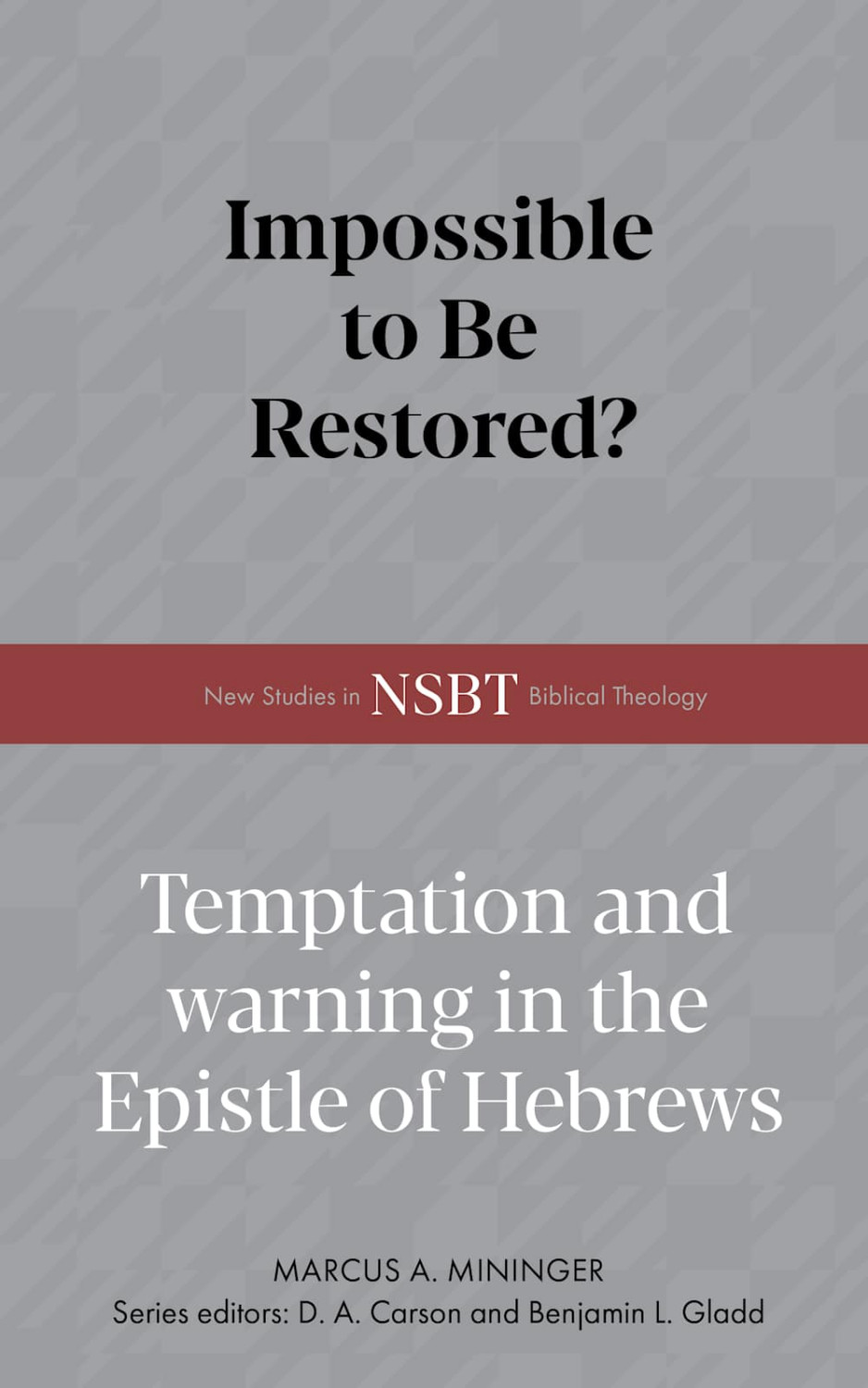
Impossible to Be Restored? Temptation and Warning in the Epistle of Hebrews, by Marcus A. Mininger. B&H Academic, 2025. Hardcover, 200 pages, $34.99. Reviewed by OP pastor Mark A. Winder.
Consultants may advise that the first things to consider when investing in real estate are location, location, and location. Biblical exegetes may advise that the first things to consider when interpreting Scripture are context, context, and context. Consistent with the careful scholarship of the New Studies in Biblical Theology series, Marcus Mininger’s Impossible to Be Restored? provides a masterclass on rigorous attention to context, thus bringing clarity to one of Scripture’s most debated passages: Hebrews 6:1–6.
Engaging both classic and contemporary scholarship, Mininger begins by examining eight distinct views, presenting strengths and weaknesses of each position. In every case, he shows that the position falls short in making its argument from within the epistle’s own literary and theological context.
Mininger discerns Hebrews’s context by exploring its self-references describing its nature, audience, and circumstances. He consistently directs the reader’s attention to three key questions: What temptation faced the original audience? What is the principal warning in response to that temptation? And, how does that help the reader better understand the letter? In addition to 6:4–6, he explores other warning texts which function as interpretive keys throughout the volume: 2:1–4 (neglecting salvation); 3:7–4:13 (do not harden your hearts); 10:19–39 (those who shrink back); and 12:15–17 (Esau’s rejection).
Mininger approaches Hebrews 6 considering the categories of covenantal foundation and fulfillment. He explores the “foundation” imagery through its ancient and biblical usage, investigating how the original audience would have understood the metaphor. Belonging to a building’s essence, a foundation was permanent, functioned as a source of strength, and was resistant to change. A careful comparison of the two lists of religious experiences in 6:1b–2 and 6:4–5 reveals that the author is describing faith in the old and new covenant eras. He is warning that it is impossible to be in right standing with God by leaving the blessings of the new covenant to return to the foundational elements of the old.
Having laid the exegetical foundation, Mininger explores its implications for understanding the phrase “impossible to be restored.” He returns to the key warning texts, observing that they describe people as having “experienced a sequence of events that bring about an irreversible change in their situation, making their return to a previous state” to be impossible (108). Those who have experienced new covenant blessings (6:4–5) cannot reject Christ and be placed in right standing before God by returning to the old covenant (6:1b–2). Mininger concludes, “What they have now experienced by entering into the new covenant and its blessings brings about a decisive change in their situation that makes a return to the arrangement of the old era and its provisions impossible” (116).
Mininger emphasizes the old covenant as essential preparation for the new, while fully recognizing its temporary, limited character (cf. Heb. 11:39–40). He is thus careful to maintain the gracious nature of the old covenant as he explores the greater substance of the new.
Does Hebrews 6 have relevance for the church today? Mininger answers this question from Hebrews’s original context and offers contemporary application. Hebrews 6 is not teaching that a person who rejects Christ may never be restored, nor is its warning merely hypothetical. Rather, when seen in the broader context of the New Testament, the warnings of Hebrews can be applied to a plethora of reasons why Christians today may be tempted to fall away from Christ, reject the blessings of the new covenant, and seek an alternative source of comfort and salvation.
Impossible to Restore? brings much-needed clarity to understanding Hebrews, particularly 6:1–6. Without sacrificing scholarly rigor, Mininger writes with precision and accessibility. The work is aided by several helpful charts and avoids unexplained technical terms. This helpful work serves as an example of how to apply the “infallible rule of interpretation of Scripture:” Scripture itself, searching those passages “that speak more clearly” to ascertain “the true and full sense” of the text (Westminster Confession of Faith 1.9).
October 11, 2026
October 04, 2026
September 27, 2026
September 20, 2026
Track: A Student’s Guide to Church
September 13, 2026
September 06, 2026
August 30, 2026
© 2026 The Orthodox Presbyterian Church


